
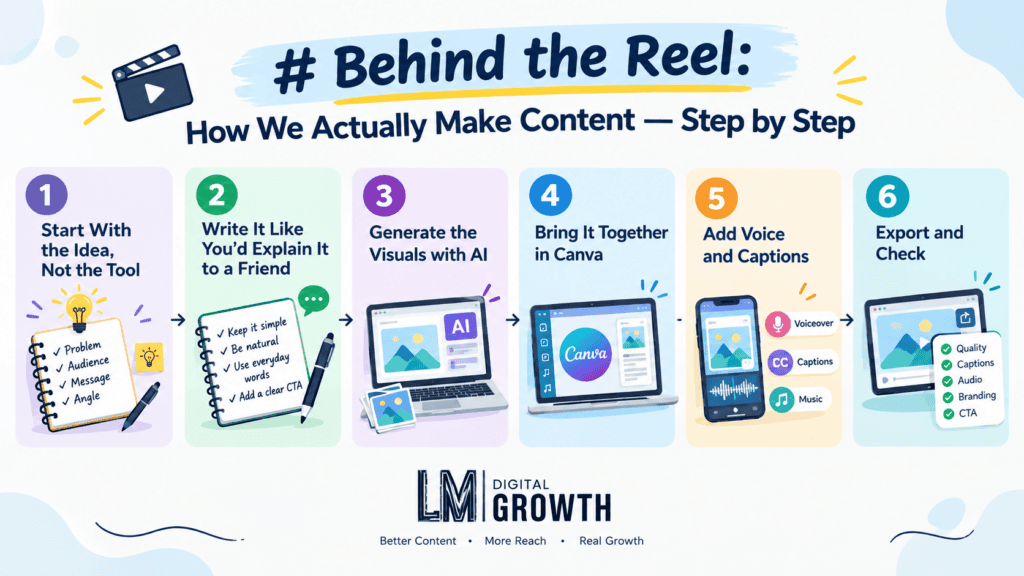
People are often surprised when I tell them there’s no camera involved in most of the Reels I make. “Then how does it look so real?” is usually the next question.
So here’s the honest, no-jargon walkthrough of what actually happens between “I have an idea” and a Reel going live.
Step 1: Start With the Idea, Not the Tool
Before opening anything, I decide what the post is actually trying to say — one clear point, not five. If a Reel is about ad budgets, it stays about ad budgets. Trying to say too much in 15 seconds is the fastest way to lose someone’s attention.
Step 2: Write It Like You’d Explain It to a Friend
The script gets written in plain, spoken language — not the stiff, formal tone a lot of business content falls into. If a line sounds like something a textbook would say instead of something a person would actually say out loud, it gets rewritten.
Step 3: Generate the Visuals with AI
This is the part that replaces the camera. Each shot gets its own visual prompt — described in detail — and an AI video tool generates a short clip for it. The key thing here that most people skip: the clip needs actual movement (a slow zoom, a pan), not a still image. A frozen picture reads as lazy, even if the picture itself looks good.
Step 4: Bring It Together in Canva
All the individual clips get placed in order, trimmed to the right length, and lined up with the script. This is also where text overlays, brand colors, and the logo get added — so it looks like your content, not a generic AI demo.
Step 5: Add Voice and Captions
A voiceover gets recorded (or generated) to match each shot, along with on-screen captions — because a large number of people watch Reels with the sound off, especially early on.
Step 6: Export and Check
Before anything goes out, it gets exported at 1080×1920, checked for blur or glitches, and watched start to finish once — the same way you’d proofread an email before sending it.
Why This Matters for You
None of this requires you to own a camera, hire a videographer, or spend a weekend filming. It just requires someone who knows how to turn an idea into a clear script, and a script into a finished video — which is the part we handle.
That’s really it — no crew, no studio, no camera gear. Just a clear idea, a good script, and the right tools stitched together with some patience.
If you’ve ever wondered how the small businesses you follow keep up with daily content, now you know it’s possible without a single day of filming. The only real question is whether you want to do this yourself, or hand it off so you can focus on running your business instead.
Curious what this could look like for your business? Get in touch, and we’ll show you.